This reading list marks the 250th anniversary of the United States. It includes books on the founding period, political development, and major social and historical changes. The titles cover well-known political figures as well as Indigenous peoples, enslaved Africans, immigrants, and social movements. Together, they provide different perspectives on U.S. history and how the country has changed over time.
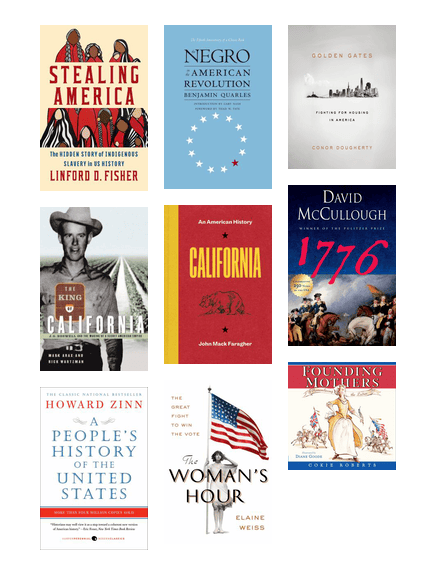
Linford D. Fisher shows that the enslavement of Indigenous peoples began soon after 1492 and spread across the Americas, ultimately involving an estimated three to six million Native individuals. While this history has often been left out of…
Quarles examines how enslaved and free Black Americans experienced the Revolution, showing that many pursued freedom by supporting either the British or the Patriots rather than embracing a single cause. It remains the foundational study of African…
Conor Dougherty examines how the San Francisco Bay Area became the epicenter of America's housing affordability crisis and argues that its experience foreshadows challenges facing cities across the United States. Through the stories of tenants,…
This extensively researched history examines the rise of J.G. Boswell, whose vast agricultural empire transformed California's San Joaquin Valley into one of the world's most productive farming regions. Through the Boswell family's story, the…
John Mack Faragher presents a sweeping history of California from Indigenous societies through Spanish colonization, the Gold Rush, statehood, immigration, industrialization, and the modern era. Rather than treating California as exceptional, he…
In this Pulitzer Prize–winning historian's account of the Revolutionary War's pivotal year, David McCullough chronicles the military campaigns and leadership that helped secure American independence. Drawing on letters, diaries, and other primary…
Howard Zinn offers a reinterpretation of American history by centering the experiences of Indigenous peoples, enslaved Africans, workers, women, immigrants, and social movements rather than political leaders and institutions alone. Spanning from…
Elaine Weiss chronicles the final campaign to secure ratification of the Nineteenth Amendment to the United States Constitution in 1920, focusing on the decisive vote in Tennessee that determined whether American women would gain the constitutional…
Cokie Roberts brings to light the often overlooked women of the American founding era, including Abigail Adams, Martha Washington, and Mercy Otis Warren, showing how they influenced political thought, supported revolutionary efforts, and shaped the…
Roxanne Dunbar-Ortiz presents a history of the United States centered on Indigenous perspectives, beginning with European colonization and continuing through centuries of land seizure, warfare, and cultural suppression. She argues that U.S.…
This narrative recounts the history of Native American nations in the nineteenth century through accounts of displacement, broken treaties, and violent conflict with the United States government. It centers Indigenous perspectives, documenting the…
Erika Lee traces the history of Asian Americans from early migration to the present, examining exclusion laws, labor exploitation, war, resettlement, and civil rights struggles. The book shows how Asian American communities shaped and were shaped by…
Bell argues that the American Revolution was a global conflict whose effects reached far beyond the thirteen colonies. He follows people, empires, and events across multiple continents to show how the war reshaped migration, trade, diplomacy, and…
Isabel Wilkerson recounts the Great Migration, when millions of African Americans left the South for cities in the North and West between 1915 and 1970. Through individual life stories, she explores how migration reshaped American cities, labor…
Doris Kearns Goodwin examines Abraham Lincoln’s leadership during the Civil War through his relationships with former political opponents whom he appointed to his cabinet. The book shows how Lincoln managed competing personalities and political…
James M. McPherson provides a comprehensive account of the United States from the political conflicts over slavery to the end of the Civil War and Reconstruction. The book explains how sectional tensions escalated into war and how the conflict…
Frederick Douglass recounts his life under slavery in Maryland, his experiences of physical and psychological abuse, and his eventual escape to freedom. The narrative exposes the brutality of slavery while tracing his journey toward literacy,…
Joseph J. Ellis examines the life and legacy of Thomas Jefferson, focusing on his contradictions as a revolutionary thinker, president, slaveholder, and advocate of liberty. The book explores how Jefferson’s public ideals often conflicted with his…
Joseph J. Ellis explores key relationships and moments among the Founding Fathers in the early republic, including debates over the Constitution, Hamilton and Burr’s rivalry, and Washington’s leadership. The book shows how personal ambition,…
Walter Isaacson presents a comprehensive biography of Benjamin Franklin, tracing his rise from apprentice printer to scientist, inventor, diplomat, and founding father. The book highlights Franklin’s curiosity, pragmatism, and political skill,…